Last Updated: April 2026
Nurse Sign-On Bonus Guide 2026: How Much, Who Pays, and How to Negotiate
Quick Answer
Nurse sign-on bonuses average $5,000–$20,000. ICU and ER nurses at major academic medical centers earn $15,000–$30,000. New grad residency bonuses run $6,000–$15,000. All bonuses come with 1–2 year clawback commitments and are taxed as ordinary income.
Sign-on bonuses have become standard at virtually every major hospital system — a direct result of the sustained nursing shortage. For nurses who know how to play the market, they represent an immediate $5,000–$30,000 addition to Year 1 total compensation. But the clawback terms matter as much as the number at the top of the offer letter.

Sign-On Bonus by Specialty (2026)
Specialty and experience level drive sign-on amounts more than any other factor. Critical care nurses with active CCRN certification routinely command the largest bonuses:
Nurse Sign-On Bonuses by Specialty (2026)
| Specialty / Role | Typical Sign-On Range | Commitment Period |
|---|---|---|
| ICU / Critical Care (experienced) | $15,000–$30,000 | 2-year commitment |
| ICU Residency (new grad) | $8,000–$15,000 | 18–24 month commitment |
| ER / Emergency (experienced) | $12,000–$22,000 | 2-year commitment |
| L&D / NICU (experienced) | $10,000–$18,000 | 2-year commitment |
| OR / Perioperative | $12,000–$20,000 | 2-year commitment |
| Med-Surg / Telemetry | $4,000–$10,000 | 12–18 month commitment |
| Home Health / Outpatient | $2,000–$6,000 | 12-month commitment |
| Rural / Critical Access Hospital | $10,000–$25,000 + loan repayment | 2–3 year commitment |
Source: NurseSalaryIntel hospital survey data, 2026
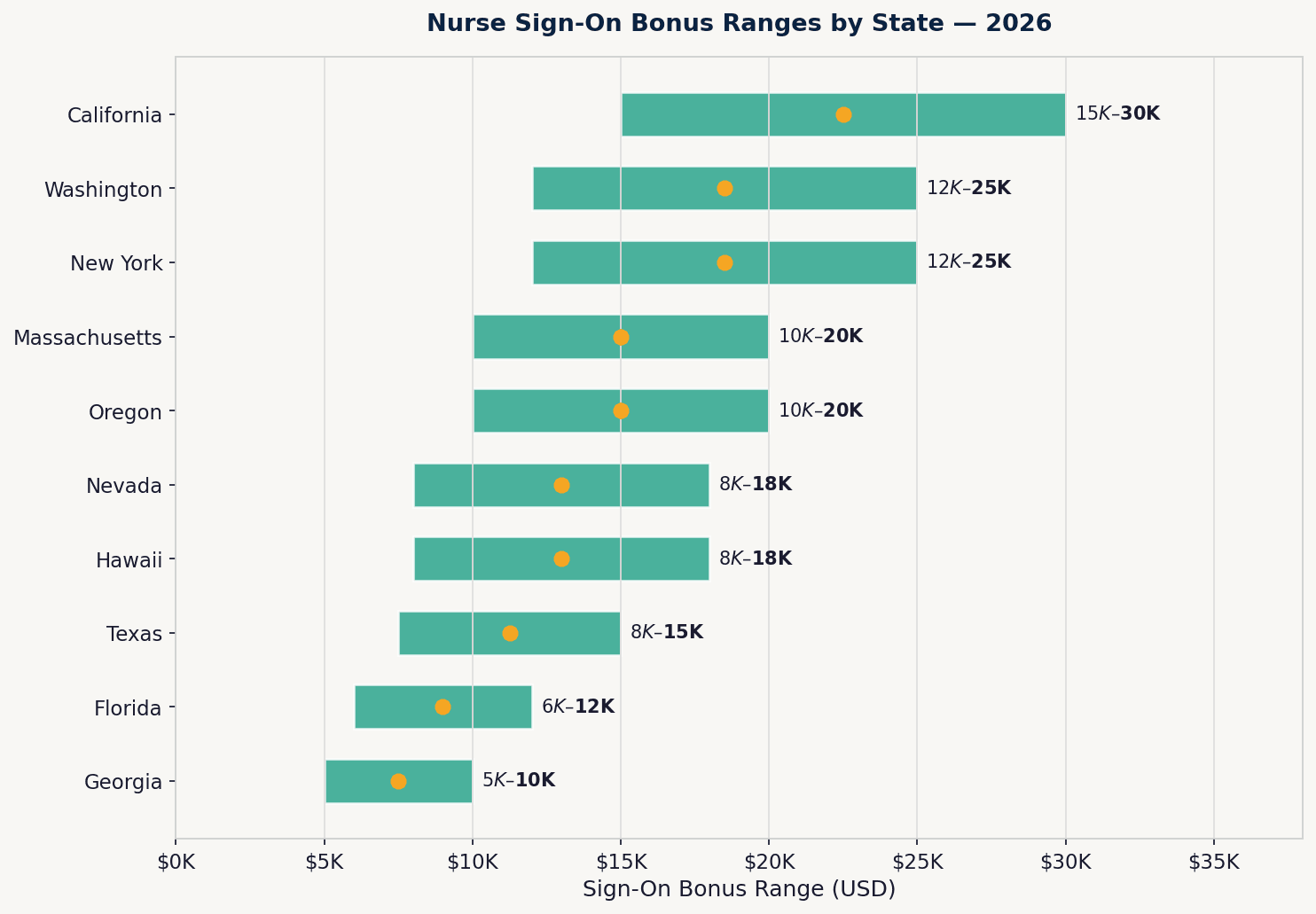
Sign-On Bonuses by State (2026)
Nurse Sign-On Bonus Ranges by State (2026)
| State | Typical Range | Notes |
|---|---|---|
| California | $15,000–$30,000 | Highest in country (union + shortage) |
| Washington | $12,000–$22,000 | Strong for ICU, ER, NICU |
| New York | $10,000–$20,000 | NYC systems most competitive |
| Texas | $8,000–$18,000 | Growing fast; HCA, Tenet lead |
| Florida | $6,000–$15,000 | Tourist area ERs pay highest |
| Midwest / Southeast | $4,000–$12,000 | Rural hospitals highest in region |
Source: NurseSalaryIntel hospital survey data, 2026
Clawback Rules: What You Must Know Before Signing
Every sign-on bonus comes with a repayment agreement. The standard structure: if you leave before the commitment period ends, you repay a prorated portion based on how much time remains. Read the fine print on three things:
- Proration method: Linear (most common) vs. step-down at 6- or 12-month intervals. Step-down can be more favorable if you need to leave at 13 months of a 24-month term.
- What triggers clawback: Voluntary resignation always triggers it. Involuntary termination for cause usually does. Layoffs and unit closures typically do not — get this in writing.
- Net repayment after taxes: You received $15,000 gross, paid taxes on it ($3,300 withheld), got $11,700 net. If you clawback, you typically repay the gross amount ($15,000) — then claim a deduction the following tax year. Understand your actual out-of-pocket exposure before signing.
How to Negotiate Your Sign-On Bonus
HR has more flexibility on sign-ons than base pay. Base pay increases are permanent line items; sign-ons are one-time costs that expire when you hit the commitment date. Use this to your advantage:
- Lead with certification: "I hold an active CCRN and have 4 years of CVICU experience — I'm targeting the upper range of your sign-on band." Certifications justify asking for $5,000–$8,000 more than the posted offer.
- Reference competing offers: Even a lower competing offer creates leverage. "I have an offer from [System B] at $18,000 — can we match or exceed that?"
- Negotiate the structure: Ask for 50% upfront, 50% at the 12-month mark (vs. full amount at start). Reduces your risk if the role isn't what was described.
- Offer a longer commitment for a larger bonus: "Would a 3-year commitment unlock a higher sign-on?" Sometimes yes — and 3 years of senior pay at $95,000+ may far outweigh the bonus difference.
For full negotiation scripts, see the nurse salary negotiation guide.

Sign-On Bonuses vs. Other Compensation
A $15,000 sign-on bonus is impressive — but compare it to what you could earn from a different negotiation strategy. A $3/hr base pay increase on a 36-hour schedule = $5,616/year, compounding with every future step increase. Over a 5-year tenure, that $3/hr raise outperforms a $15,000 one-time bonus by $13,080. Prioritize base pay first; take the sign-on as the secondary win.
Related Salary Guides
Nurse Salary Negotiation Scripts
Word-for-word scripts for base pay + sign-ons
New Grad RN Salary 2026
First-year pay + residency sign-on bonuses
ICU vs ER Nurse Salary 2026
Which specialty commands the largest sign-ons
Travel vs Staff Nurse Pay
When travel contracts beat sign-on bonuses
Sources
- BLS OEWS — Registered Nurses, National and State Data
- AACN — Nursing Shortage Fact Sheet
- IRS Topic No. 419 — Gambling Income and Losses (Supplemental Wage Withholding context)
📊 Data Methodology
Salary figures on this page are 2026 estimates derived from the most recent available U.S. Bureau of Labor Statistics Occupational Employment and Wage Statistics (OEWS) data, based on the May 2024 survey and published in March 2025. Estimated ranges may also incorporate publicly available 2025 job postings, hospital pay schedules, regional market conditions, and reported compensation trends.
Official 2026 OEWS wage data has not yet been released. All salary figures on this page should be treated as informational estimates rather than official government statistics or guaranteed compensation rates.
Frequently Asked Questions
What is the average nurse sign-on bonus in 2026?
Do you have to pay back a sign-on bonus if you leave early?
Can you negotiate a nurse sign-on bonus?
Are nurse sign-on bonuses taxed?
Which hospitals pay the highest nursing sign-on bonuses?
Download your free nursing contract audit kit — scripts, checklists, and counter-offer language
- ✓ Word-for-word counter-offer emails for each red flag clause
- ✓ Scripts for negotiating with recruiters by phone
- ✓ Legal addendum language to modify bad clauses
- ✓ What to say if they push back or say "it's standard"
Instant access · Free · No credit card