Last Updated: April 23, 2026
Nurse Salary Negotiation Scripts (2026): Email + Counteroffer Templates
If you've ever accepted a nursing offer within 24 hours of receiving it, you've likely left money on the table. In 2026, hospitals expect to negotiate — most have 3–8% of wiggle room on base, plus broader flexibility on sign-on bonuses, shift assignment, and certification reimbursement. This guide gives you the scripts. Copy, paste, adjust, send.
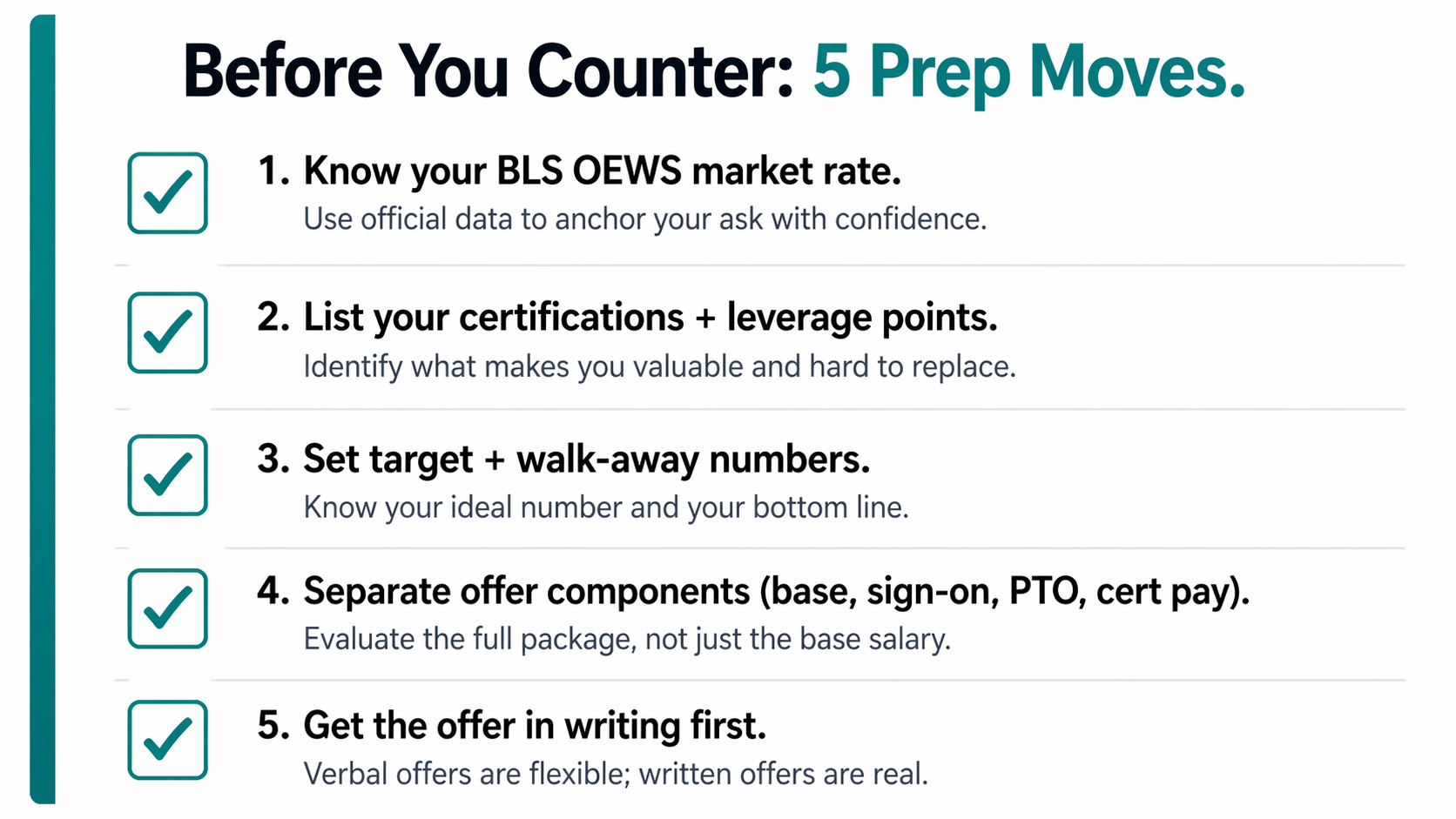
Before You Open Email: 5 Prep Moves
- Know your market rate. Pull your metro from BLS OEWS or use our RN Salary Calculator. Know the 50th, 75th, and 90th percentile for your specialty.
- Know your leverage. Certifications (CCRN, CEN, PCCN, OCN), years of experience, BSN/MSN, and competing offers are all leverage. Hard-to-fill specialties (ICU, ER, OR) have more leverage than med-surg.
- Have a target + a walk-away number. Target is what you'll push for. Walk-away is the number below which you decline.
- Separate the offer components. Base hourly, sign-on, differentials, certification pay, PTO, 401(k) match, tuition reimbursement, relocation. Negotiate these separately.
- Get it in writing. Verbal offers aren't offers. Always ask for the full offer in writing before you counter.
See our full salary negotiation guide for the strategic framework behind these tactics.
Script 1: Initial Counteroffer Email (Post-Offer)
This script thanks the recruiter, anchors on specific BLS data, makes one primary ask with a specific number, and bundles secondary asks. The closing signals genuine intent to accept — recruiters advocate harder for candidates they believe are closable.
Script 2: Short-Form Counteroffer (When You Want to Move Fast)
Use this when you already have a relationship with the recruiter or when you have a competing offer with a time pressure. Speed wins deals when the role is hot.
Script 3: Counteroffer With a Competing Offer
A competing offer is the single strongest lever in a negotiation. Never bluff one you don't have — recruiters check.
Script 4: Negotiating the Sign-On Bonus Only
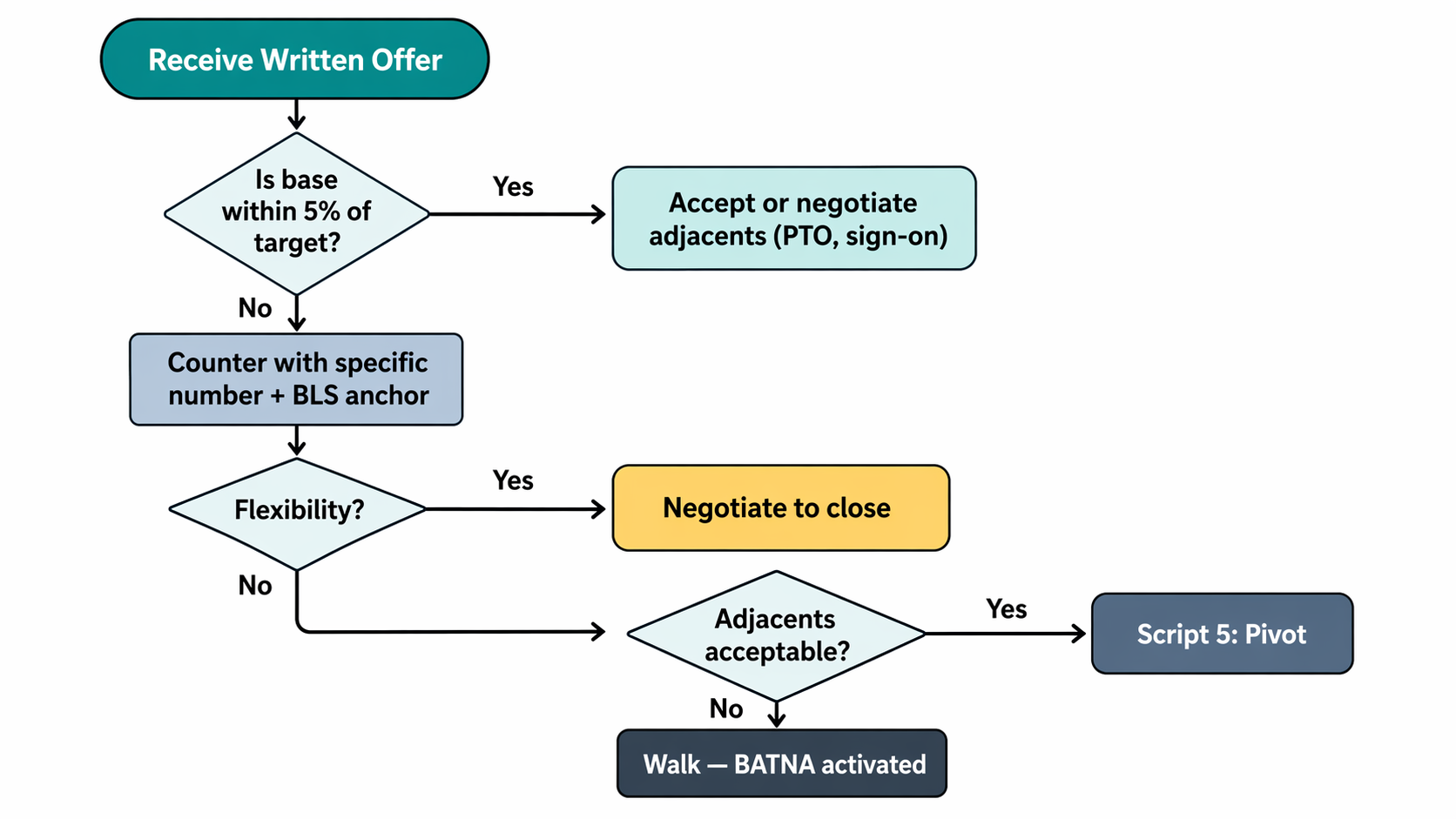
Script 5: Responding to "The Number Is Firm"
When "base is firm" is real — common in union environments or large systems with rigid step scales — pivot to everything else. Each of these items has real dollar value.
Script 6: New-Grad Negotiation Email
Script 7: Verbal Counter on a Phone Call
Use when the recruiter calls to deliver a verbal offer and you want to counter in the moment.
- You: "Thanks — I really appreciate the offer. Before I give you a yes, can I ask a few clarifying questions?"
- You: "What's the step I'm placed at, and what's the hourly base at that step?"
- You: "What's the sign-on, and what's the commitment term?"
- (Once you have the full picture — pause, do the math, then:)
- You: "Based on my [X years + certification], I was expecting closer to $[X]/hr at step [X+1]. Is there any flexibility in where I'm placed on the ladder?"
- (If they need to check:)
- You: "Take whatever time you need — can you follow up by email so I have the final numbers in writing?"
"I was expecting closer to" is the most useful phrase in a phone negotiation — it's soft but anchors a specific number. Do not fill silences.
How Much Room Is Actually There? 2026 Estimates
Typical 2026 Negotiation Ranges by Offer Component
| Offer Component | Typical 2026 Negotiation Range |
|---|---|
| Base hourly (non-union) | +$1–$4/hr above initial offer |
| Base hourly (union) | +0 to +1 step (often fixed) |
| Sign-on bonus (med-surg) | +$2,000–$5,000 |
| Sign-on bonus (ICU/ED/OR) | +$5,000–$15,000 |
| Certification differential | +$1–$3/hr (often ongoing) |
| Relocation | $2,000–$8,000 |
| PTO accrual rate | Up to +1 step (experienced hires) |
| Tuition reimbursement | +$2,500–$5,250 annually |
Source: Public compensation survey summaries and hospital HR norms. Actual flexibility varies by system.
Common Pushback and What to Say
"Our pay is set by the scale — it's not negotiable."
→ "Understood — can you tell me where on the scale I'm being placed, and what case I can make for a higher step?"
"This is a competitive offer for the market."
→ "Based on BLS OEWS for [Metro], my target is closer to $[X]/hr. Is there room in step placement, sign-on, or differential to get there?"
"We'd have to check with the hiring manager."
→ "Can I send you a short email summarizing what I'm asking for, to make it easier to share internally?"
"The sign-on bonus is fixed."
→ "Is the commitment term fixed too? A shorter commitment period on the same bonus would also work for me."
What NOT to Do
- Don't negotiate before you have the written offer in hand
- Don't mention salary until they mention it first (early in the process)
- Don't threaten to walk unless you will actually walk
- Don't accept verbally — always "I'd like to review and get back to you in 24–48 hours"
- Don't bluff a competing offer you don't have
- Don't focus only on sign-on and ignore base (one-time vs. compounding)
State and Specialty Data to Plug Into Your Scripts
For state-specific market rates to anchor your counter:
For specialty premiums to cite:
Sources: US Bureau of Labor Statistics OEWS, May 2024 (29-1141); Society for Human Resource Management, compensation practices publications. Scripts and ranges are educational guidance, not guarantees of outcome. Actual flexibility varies by employer, state, union status, and individual circumstances. Not career or financial advice.
📊 Data Methodology
Salary figures on this page are 2026 estimates derived from the most recent available U.S. Bureau of Labor Statistics Occupational Employment and Wage Statistics (OEWS) data, based on the May 2024 survey and published in March 2025. Estimated ranges may also incorporate publicly available 2025 job postings, hospital pay schedules, regional market conditions, and reported compensation trends.
Official 2026 OEWS wage data has not yet been released. All salary figures on this page should be treated as informational estimates rather than official government statistics or guaranteed compensation rates.
Frequently Asked Questions
Do nurses really negotiate salary, or is it always fixed?
Should I negotiate a new grad RN offer?
What's the best script to use if I have a competing offer?
How do I respond when HR says the number is firm?
Is it okay to negotiate by email, or should I call?
How much can I negotiate as an ICU nurse?
What's the biggest mistake nurses make in negotiation?
Can I ask for a BSN differential?
How do I negotiate if I'm changing specialties?
Should I mention my current salary?
Do travel nurses negotiate?
When in the interview process should I bring up salary?
Download your free nursing contract audit kit — scripts, checklists, and counter-offer language
- ✓ Word-for-word counter-offer emails for each red flag clause
- ✓ Scripts for negotiating with recruiters by phone
- ✓ Legal addendum language to modify bad clauses
- ✓ What to say if they push back or say "it's standard"
Instant access · Free · No credit card