Last Updated: May 2026
Nurse Salary Cost of Living 2026: What Your Pay Actually Buys in 15 Cities
The Finding
A nurse earning $83,500 in Houston has more real purchasing power than a nurse earning $96,000 in Boston or New York — once cost of living and state income taxes are factored in. The gap between nominal salary and actual purchasing power is the most underused tool in nurse job comparisons.

Every nurse salary comparison you read online uses nominal pay — the number on the job posting before taxes, before housing, before the reality of what $89,000 actually buys in San Francisco versus Indianapolis. The honest comparison requires two adjustments: state income tax and cost of living. When you apply both, the salary rankings look dramatically different from what most nurses expect.
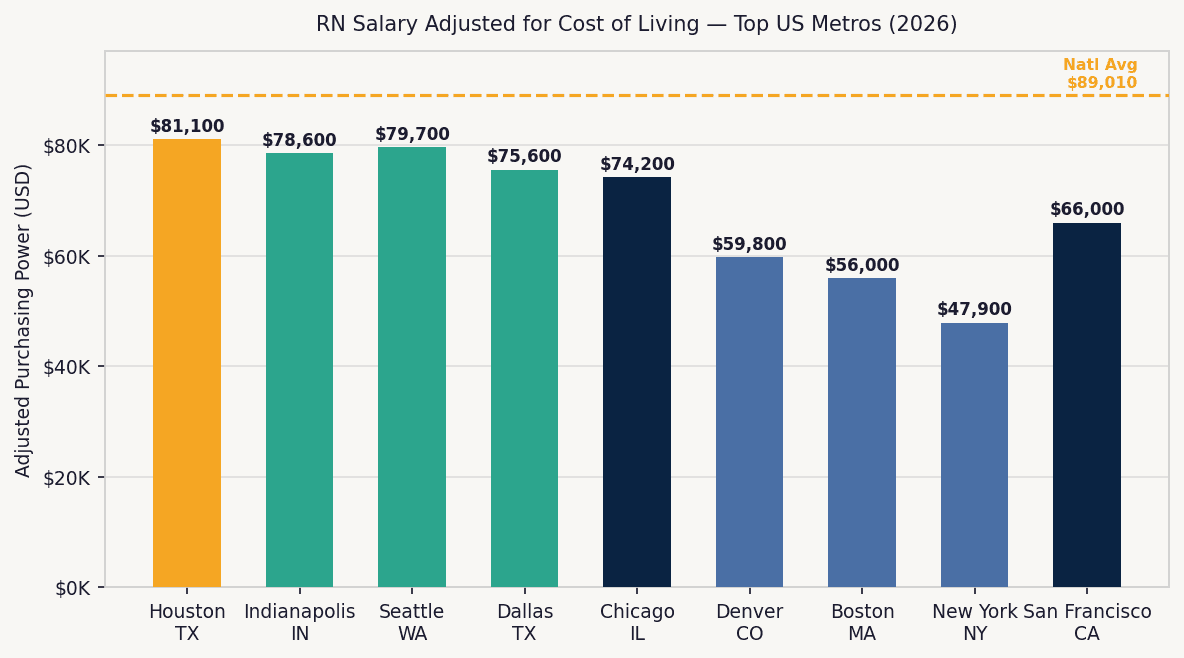
RN Salary by Metro: Nominal vs. Adjusted Purchasing Power (2026)
The table below shows nominal BLS OEWS salary data for each metro alongside the estimated cost-of-living index and a rough adjusted purchasing power figure. Adjusted values use composite COL indices from C2ER 2024 data and are intended for directional comparison — not exact financial planning. Tax impact shown is estimated effective state income tax on the median salary for that market.
RN Salary vs. Adjusted Purchasing Power by Metro (2026)
| Metro | Nominal Annual Salary | COL Index | Tax | Adjusted |
|---|---|---|
| Houston, TX | $83,500 | COL 103 | No state tax | Adj. ~$81,100 |
| Indianapolis, IN | $71,500 | COL 91 | 3.15% flat tax | Adj. ~$78,600 |
| Nashville, TN | $67,000 | COL 107 | No state income tax | Adj. ~$62,600 |
| Phoenix, AZ | $78,500 | COL 110 | 2.5% flat tax | Adj. ~$71,400 |
| Dallas, TX | $80,900 | COL 107 | No state tax | Adj. ~$75,600 |
| Chicago, IL | $83,580 | COL 107 | 4.95% flat tax | Adj. ~$74,200 |
| Denver, CO | $79,000 | COL 132 | 4.4% flat tax | Adj. ~$59,800 |
| Atlanta, GA | $71,600 | COL 108 | ~5.49% effective | Adj. ~$62,800 |
| Seattle, WA | $110,000 | COL 138 | No state tax | Adj. ~$79,700 |
| Boston, MA | $96,000 | COL 162 | 5% flat tax | Adj. ~$56,000 |
| New York, NY | $96,000 | COL 187 | ~6.85% effective | Adj. ~$47,900 |
| San Francisco, CA | $133,340 | COL 180 | ~11% effective | Adj. ~$66,000 |
| National Average | $89,010 | COL 100 baseline |
Source: BLS OEWS May 2024; C2ER cost-of-living indices 2024; NurseSalaryIntel 2026 analysis
The Tax Advantage You're Not Counting
Nine US states have no state income tax, and three of the top nursing markets are among them: Texas, Washington, and Florida. For nurses comparing offers across state lines, this is a significant real-dollar difference that rarely appears in job posting comparisons.
State Income Tax Impact on Nurse Take-Home Pay
| State / Market | State Income Tax Rate | Annual Tax Impact |
|---|---|---|
| Texas (Houston, Dallas) | $0 | 9 states with no income tax |
| Washington (Seattle) | $0 | No income tax; highest nominal wages |
| Florida (Tampa, Miami) | $0 | No income tax + Sunbelt growth |
| Indiana (Indianapolis) | 3.15% flat | ~$2,250/yr on $71,500 salary |
| Colorado (Denver) | 4.4% flat | ~$3,480/yr on $79,000 salary |
| Illinois (Chicago) | 4.95% flat | ~$4,137/yr on $83,580 salary |
| Massachusetts (Boston) | 5% flat | ~$4,800/yr on $96,000 salary |
| New York (NYC) | ~6.85% effective | ~$6,576/yr on $96,000 salary |
| California (SF, LA) | ~11% effective | ~$14,667/yr on $133,340 salary |
Source: IRS + state revenue department rates 2026; NurseSalaryIntel estimates
The starkest example: a nurse moving from Houston (no state tax, COL 103) to Boston (5% flat tax, COL 162) for a $96,000 offer is taking a real-dollar cut despite the $12,500 nominal raise. After Massachusetts income tax and a 57% higher cost of living, the purchasing power equivalent is roughly $56,000 — well below Houston's adjusted value.
Where Nurses Get the Most for Their Money

Houston, TX consistently wins the adjusted purchasing power comparison. No state income tax, a COL index of roughly 103, and access to the Texas Medical Center — the world's largest medical complex — combine to make it one of the best real-value nursing markets in the country. A Houston nurse earning $83,500 keeps more of that pay than most nurses in higher-nominal cities.
Indianapolis, IN is an underrated market. The COL index sits around 91 — meaningfully below the national average — and the Indiana flat income tax rate of 3.15% is among the lowest in the country. Major health systems including IU Health and Ascension St. Vincent compete for nurses in a relatively affordable metro. Adjusted purchasing power rivals markets that appear much more attractive on paper.
Seattle, WA threads the needle. Nominal salary averages $110,000, Washington has no state income tax, but COL runs roughly 38% above the national average — primarily housing. The adjusted value lands around $79,700, which is genuinely strong. For nurses relocating from California, Seattle often represents a real improvement in both nominal pay and after-tax take-home.
Where the Math Works Against You
New York City sits at the bottom of the adjusted rankings. A $96,000 nominal salary faces a COL index of roughly 187 and a combined New York State + City effective tax rate that can reach 10–11%. The adjusted purchasing power drops to approximately $47,900 — less than a new grad RN earns in Houston. The city is not a financial winner for most nurses despite appearing competitive on paper.
San Francisco nominally leads all markets at $133,340, but California's 11%+ effective state income tax rate and a COL index near 180 drag the adjusted figure to approximately $66,000. For experienced specialty nurses — ICU, OR, CRNA — the gap may narrow considerably, and the career development opportunities at UCSF and Sutter are real. But for mid-career nurses comparing offers, the numbers support moving to no-tax, lower-COL markets unless career or personal factors favor the Bay.
How to Run This Comparison for Your Offer
When you receive an offer in a new market, run this four-step comparison before deciding:
Step 1: Get the after-tax number. Use your state's income tax estimator (most state revenue websites have one). Subtract estimated state + federal income tax from gross salary to get your approximate annual net income.
Step 2: Apply the COL index. Divide your net income by the destination city's COL index divided by 100. This normalizes your purchasing power to a national baseline. C2ER publishes quarterly COL indices — use their data or NerdWallet's city comparison tool.
Step 3: Compare housing specifically. COL indices blend many categories. If you're renting, housing matters most — check Zillow or Apartments.com for current 1BR/2BR market rates in both locations. A $500/month housing cost difference is $6,000/year that no salary negotiation can easily offset.
Step 4: Factor shift differential and benefits. Two identical base salaries can differ by $12,000–$20,000/year in total compensation once night differential, overtime structure, retirement match, and health insurance cost are included. The offer that looks lower may win on total value.
Related Salary Guides
Nurse Salary Negotiation Guide 2026
Scripts and framework for any offer
Shift Differential Pay 2026
How night/weekend pay adds $8K–$25K/yr
Houston RN Salary 2026
The strongest adjusted-value market
Seattle RN Salary 2026
High nominal + no state income tax
Sources
- BLS OEWS — Registered Nurses, by Metropolitan Area (May 2024)
- C2ER — Council for Community and Economic Research, ACCRA Cost of Living Index 2024
- Tax Foundation — State Income Tax Rates 2026
📊 Data Methodology
Salary figures on this page are 2026 estimates derived from the most recent available U.S. Bureau of Labor Statistics Occupational Employment and Wage Statistics (OEWS) data, based on the May 2024 survey and published in March 2025. Estimated ranges may also incorporate publicly available 2025 job postings, hospital pay schedules, regional market conditions, and reported compensation trends.
Official 2026 OEWS wage data has not yet been released. All salary figures on this page should be treated as informational estimates rather than official government statistics or guaranteed compensation rates.
Frequently Asked Questions
Which city has the best purchasing power for nurses in 2026?
Do California nurses actually take home more money than Texas nurses?
What cities offer the best nurse salary after cost of living?
Does state income tax matter for nurses when comparing salaries?
How do I calculate my real purchasing power as a nurse?
Download your free nursing contract audit kit — scripts, checklists, and counter-offer language
- ✓ Word-for-word counter-offer emails for each red flag clause
- ✓ Scripts for negotiating with recruiters by phone
- ✓ Legal addendum language to modify bad clauses
- ✓ What to say if they push back or say "it's standard"
Instant access · Free · No credit card